

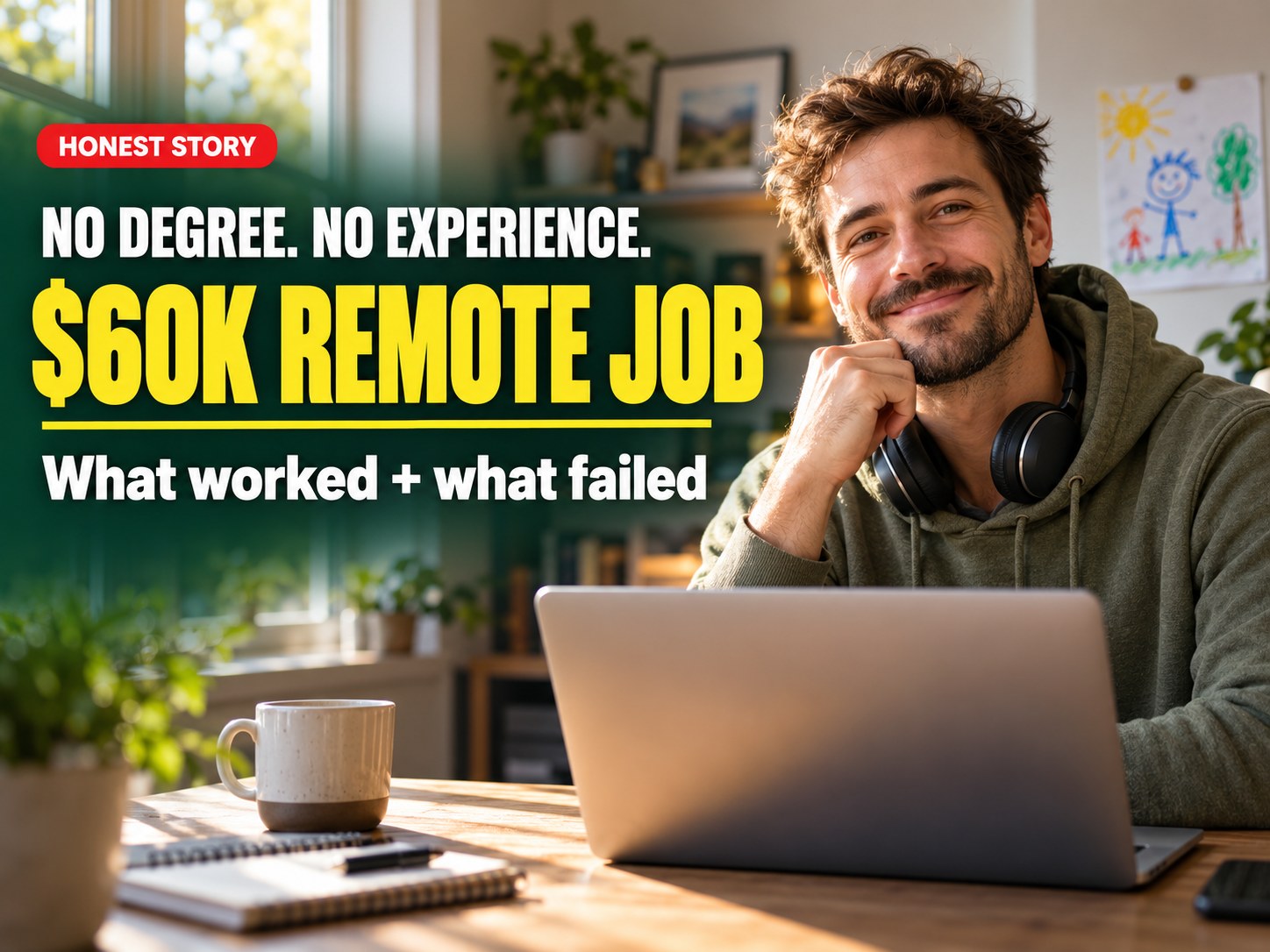
I got a $60K remote job with no degree, no connections, and a résumé that looked like a list of warehouse shifts and odd jobs. Here’s exactly what I did, and what failed, so you don’t burn the months I burned.
You’ve probably seen posts like this before. Somebody claims they “broke into tech” in 30 days, then tries to sell you a $2,000 course. So if you’re skeptical right now, good. You should be.
This isn’t a highlight reel. I’m going to show you the ugly part first: the certificates that went nowhere, the hundreds of applications into the void, the interview I bombed. Then I’ll walk you through the specific path that actually worked, which role I chose, how I prepared, and what the money really looks like.
Because the thing that finally got me hired wasn’t what I expected at all.
Where I Started: No Degree, No Network, No Plan
Let’s be honest about the starting line. I had no college degree, no office experience, and nobody in my life working a remote job I could ask for help.
What I did have was a family to take care of and a strong feeling that trading hours for low pay wasn’t going to get us anywhere. I wanted a job I could do from home, that paid real money, and that didn’t require four years and a mountain of debt to qualify for.
If that sounds like you, keep reading. The gap between where you are and a high-paying remote job is smaller than you think. It’s just not where most people look.
What Failed First (So You Can Skip It)
Before anything worked, I wasted about four months doing what the internet told me to do. Here’s what didn’t move the needle:
- Collecting random certificates. I finished a couple of online courses in things I had no real plan for. Nice PDFs. Zero callbacks.
- Mass-applying to anything with “remote” in the title. I sent 150+ applications with the same résumé. The silence was deafening.
- Chasing “easy” remote jobs. Data entry and survey gigs paid so little that I’d have been better off keeping my old job.
- Hiding my non-traditional background. I tried to make my résumé sound corporate. It just made me sound like everyone else, minus the degree.
- Waiting until I felt “ready.” I kept thinking one more course would make me qualified. It never did.
The core mistake was simple: I was trying to look qualified on paper instead of picking one role where paper didn’t matter much.
Pro tip: If a remote job is “easy” to get with no skills, it usually pays like it. Look for roles where employers hire for attitude and trainability, not credentials. That’s where the gap between effort and pay is widest.
Why I Chose Entry-Level Tech Sales Over Every Other Remote Path
Once I stopped spraying applications, I asked a better question: which remote jobs without a degree actually pay well from day one?
The answer kept coming back to one role: the Sales Development Representative, or SDR.
What an SDR actually does
An SDR is the first point of contact between a software company and potential customers. You research companies, send emails, make calls, and book meetings for more senior salespeople to close.
You’re not closing big deals on day one. You’re starting conversations. That’s a skill you can learn, and a lot of people already have more of it than they realize.
Why it works if you have no degree
- Many software companies care more about drive, coachability, and communication than a diploma.
- The work is measurable. Meetings booked is a number, and numbers beat credentials.
- Pay is usually a base salary plus commission, so total earnings can land in the $50K–$75K range even at entry level.
- There’s a clear promotion path to Account Executive, where earnings can climb well past six figures.
If you want a full breakdown of the role, the pay, and whether it fits your personality, I put everything in my honest tech sales review. [LINK: tech sales review]
I Got a $60K Remote Job With No Degree — Here’s Exactly What I Did (and What Failed)
This is the part you came for. Once I committed to the SDR path, this is the process that took me from ghosted to hired in about eight weeks:
- I picked one target. Remote SDR roles at software companies. Nothing else. One role, one résumé, one story.
- I learned the basics fast. I studied how sales teams work: prospecting, cold email, cold calling, handling objections, and the tools SDRs use every day. Weeks, not years.
- I rewrote my résumé around results. My old jobs became proof of sales skills: hitting targets, dealing with difficult customers, showing up consistently, working under pressure.
- I stopped hiding my story. “Dad with no degree who taught himself sales because he wanted more for his family” is memorable. Hiring managers remember stories, not bullet points.
- I reached out directly. Instead of only applying online, I messaged sales managers and SDRs on LinkedIn at companies I liked. Short, specific, respectful. That’s basically the job itself.
- I practiced mock calls out loud. I recorded myself doing pretend cold calls and fixed what sounded awkward. It felt ridiculous. It also made the interviews feel easy.
- I treated interviews like sales calls. I researched each company, asked sharp questions, and ended every interview by asking directly if there was anything stopping them from moving me forward.
The interview that failed
My first real interview went badly. I was asked to do a live role-play, and I froze. I talked too much, didn’t ask questions, and never asked for the next step.
That rejection stung, but it showed me exactly what to practice. Two interviews later, I got the offer.
Pro tip: End every SDR interview with: “Based on our conversation, is there anything that would stop you from moving me to the next round?” It shows the exact skill they’re hiring for, and it gives you a chance to handle objections on the spot.
What $60K Actually Looks Like (Base, Commission, and Reality)
Let’s talk money honestly, because a lot of posts don’t.
My offer was around $60K in on-target earnings. That typically means a guaranteed base salary plus commission you earn by hitting your meeting targets. A common split is somewhere around 60/40 or 70/30, base to commission.
The good
- Work from home, no commute, more time with the kids.
- Hit your numbers and you can earn above your target.
- Training, tools, and a clear path to promotion.
The real
- Rejection is part of the job. Most calls and emails won’t go anywhere.
- Miss your targets and your paycheck feels it.
- The first few months are a steep learning curve.
One thing nobody told me: always ask what percentage of the team actually hits quota. A $60K offer where most reps hit target is worth more than a $70K offer where almost nobody does. That single question tells you how realistic the number on paper really is.
For me, the trade was worth it. A few hard months in exchange for a real career with room to grow? I’d make that deal again.
How to Copy This Plan Without Wasting Months
You don’t need to repeat my mistakes. Here’s the short version of what I’d do if I were starting from zero today:
- Commit to one role. For most beginners chasing high-paying remote jobs with no experience, entry-level tech sales is the strongest bet.
- Learn the fundamentals in weeks. Prospecting, cold outreach, objection handling, basic sales tools.
- Turn your past into proof. Every job has taught you something a sales team values.
- Network before you apply. One genuine message to a sales manager can beat 50 cold applications.
- Practice out loud. Role-plays are where most candidates lose. Rehearse until it feels natural.
I turned this whole roadmap into a free step-by-step guide so you don’t have to piece it together from random videos. [LINK: free guide]
Pro tip: Block one hour a day, every day, for 30 days. Split it between learning, outreach, and practice. Consistency beats intensity, and it’s exactly the habit that SDR work rewards.
Frequently Asked Questions
Can you really get a $60K remote job without a degree?
Yes, especially in sales. Many software companies hire SDRs based on communication skills, drive, and coachability rather than a diploma. The $60K figure usually refers to on-target earnings, meaning base plus commission. It’s realistic, but you’ll have to earn part of it by hitting your targets.
What is the easiest high-paying remote job to get with no experience?
“Easy” and “high-paying” rarely go together, but entry-level tech sales comes closest. The barrier to entry is lower than most tech roles because you don’t need to code or design. What you need is persistence, a willingness to hear “no,” and the ability to learn fast. For the pay you can earn in year one, few roles compare.
How long does it take to become an SDR with no experience?
For many people, it takes somewhere between one and four months of focused effort. That includes learning the basics, rebuilding your résumé, networking, and interviewing. It took me longer because I spent months on the wrong things first. With a clear plan, you can move much faster.
Do I need a certification to get a remote sales job?
No. Certifications can help you learn, but hiring managers care far more about how you communicate and how you handle a role-play. A sharp LinkedIn message and a confident mock call will do more for you than a certificate. Spend your time on skills you can demonstrate.
Is tech sales a good career for parents who need flexibility?
For many parents, yes. Remote SDR roles cut out the commute and give you more time at home. That said, you’ll have set hours for calls and meetings, and the work is performance-based. If you can protect focused blocks of time each day, it can fit family life well.
Your Next Move
I got a $60K remote job with no degree, and here’s exactly what I did (and what failed) boiled down to one sentence: stop trying to look qualified for everything, and get very good at one role that rewards effort over credentials. For most people starting from zero, that role is entry-level tech sales.
You don’t need permission, a diploma, or perfect timing. You need a clear target, a few weeks of focused learning, and the nerve to reach out to real people. That’s it. The rest is repetition.
If you want the exact roadmap I wish I’d had on day one, grab my free guide [LINK: free guide]. And if you want to go deeper with me step by step, join the masterclass [LINK: masterclass]. Your first $60K remote year starts with the next hour you put in.



Leave a Reply