

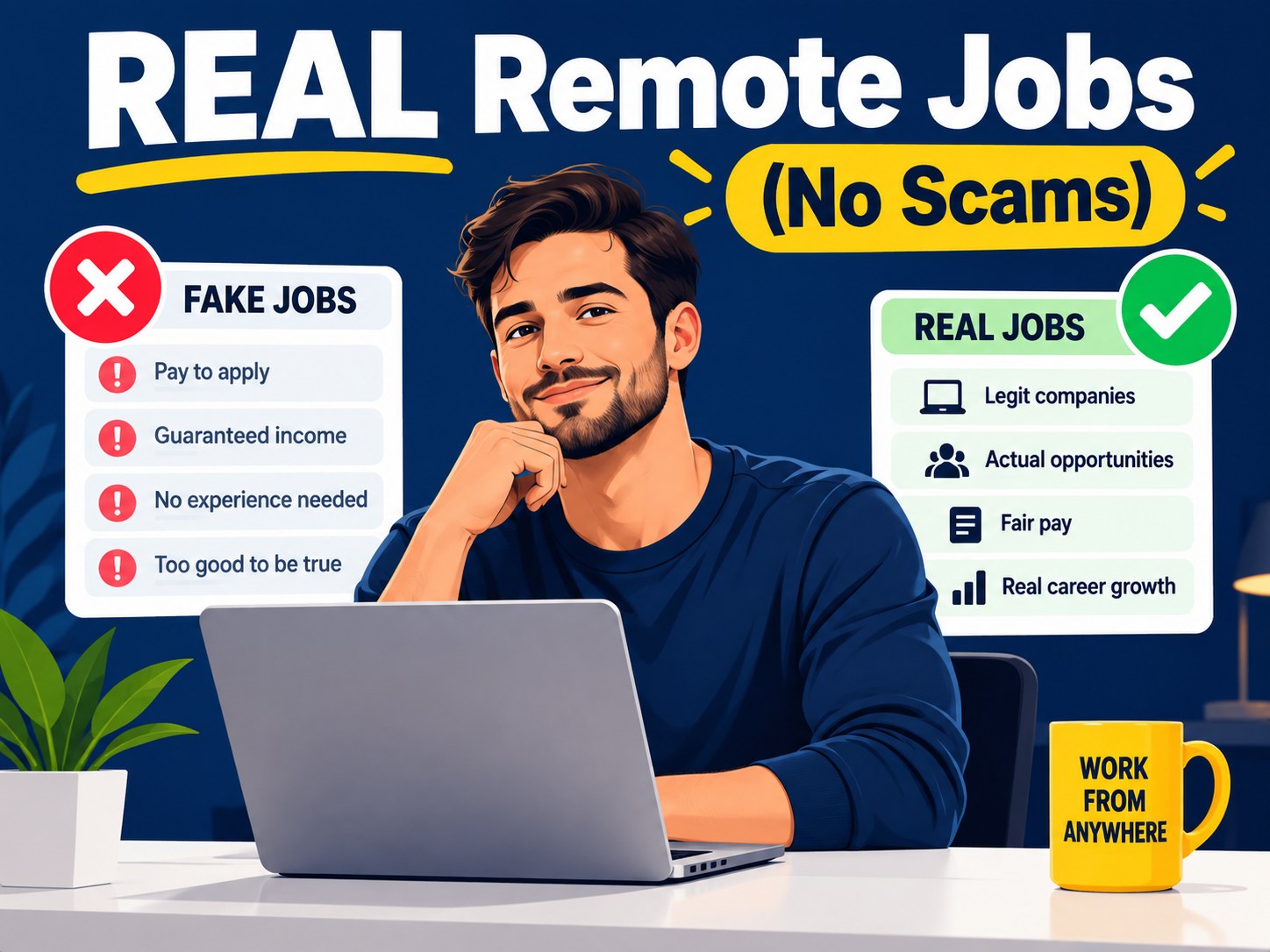
You’ve been burned before. Or you know someone who has.
You searched for remote jobs, clicked a promising link, and ended up on a page asking you to pay for a “starter kit” or “training certification” before you could earn a single dollar. Maybe you filled out an application and got a reply asking for your bank account number. Maybe the “job” turned out to be recruiting other people to do the same thing.
It’s exhausting. And it makes people give up on remote work entirely — which is a real shame, because legitimate work from home jobs that are not scams absolutely exist. Plenty of them. Some pay $60,000, $80,000, even six figures. No degree required. No prior experience in the field. Just the right skills, the right job boards, and the ability to tell the real from the fake.
That’s what this post is for. By the time you finish reading, you’ll know exactly which remote jobs are real, which red flags to watch for, and how to start applying with confidence — not fear.
How to Tell If a Work From Home Job Is a Scam
Before we get to the good stuff, let’s talk about the filter you need. Because the problem isn’t that legitimate remote jobs are rare — it’s that scams are loud and real opportunities are often quieter.
Here are the clearest red flags:
- They ask you to pay anything upfront. A real employer never charges you to work for them. “Training fees,” “background check fees,” or “starter kits” are scam signals, full stop.
- The pay sounds absurd. $500/day with zero experience and no interview? No. Real high-paying remote jobs exist, but they require a real process.
- The job description is vague. “Work from home, make money online, flexible hours, be your own boss” — that’s not a job description. That’s a pitch.
- They found you first. If someone DM’d you on Instagram or Facebook offering you a remote job you didn’t apply for, it’s almost certainly a scam.
- There’s no company name, address, or verifiable online presence. Legitimate companies have LinkedIn pages, Glassdoor reviews, and a real website.
- They want your personal info before any formal offer. Social Security numbers and banking details only come after a written offer and a real onboarding process.
Pro tip: Before any interview, Google the company name + “scam” or “reviews.” Check Glassdoor and LinkedIn. If you can’t find them anywhere, walk away.
Legitimate Work From Home Jobs That Are Not Scams
Let’s get into what actually works — and where to find it.
1. Tech Sales (SDR / Account Executive)
This is one of the highest-paying entry-level remote careers that most people have never heard of. Sales Development Representatives (SDRs) make $45,000–$75,000 in base salary, with commissions pushing total comp to $80,000–$100,000+. Companies train you. You don’t need a degree. You need communication skills and persistence.
This is the path I recommend most often on this site. We have a full breakdown at [LINK: tech sales review] if you want the details.
2. Customer Success / Account Management
Remote customer success roles are everywhere. You’re the point of contact between a software company and its clients — helping them get value from a product, answering questions, and reducing churn. Starting salaries range from $40,000–$65,000, with a clear growth path into account management and beyond.
3. Virtual Assistant
VA work is flexible, genuinely remote, and wide open for beginners. Tasks range from inbox management and scheduling to research and social media. You can start at $20–$30/hour and build up quickly with the right clients. Platforms like Belay, Time Etc., and Fancy Hands hire regularly.
4. Remote Data Entry / Admin
Lower barrier to entry, lower pay to start — but real, legitimate work. Companies like Lionbridge, TELUS International, and Clickworker hire for these roles regularly. It won’t make you rich, but it’s a real paycheck while you build toward something bigger.
5. Online Tutoring and Course Facilitation
If you have knowledge in any subject — math, English, a second language, coding basics — platforms like Tutor.com, Preply, and Cambly pay you for that. Hourly rates vary from $15–$50 depending on subject and platform.
6. Freelance Writing and Content Creation
Businesses need content. Blog posts, email newsletters, product descriptions, social copy. If you can write clearly, there’s work available. Start on platforms like ProBlogger’s job board or Contena, or pitch directly to small businesses.
7. Remote Tech Support
Companies like Apple, Amazon, and countless SaaS businesses hire remote tech support agents. Starting pay is $18–$28/hour. You don’t need a degree — just strong troubleshooting skills and the ability to communicate clearly under pressure.
Where to Find Legitimate Remote Jobs (The Right Job Boards)
Not all job boards are equal. Some are flooded with scams. Here’s where the real listings live:
- LinkedIn — Filter by “Remote” and use the Easy Apply feature strategically. Follow companies you want to work for.
- We Work Remotely (weworkremotely.com) — One of the cleanest remote-specific job boards online.
- Remote.co — Curated listings, mostly tech and professional roles.
- FlexJobs — Paid subscription, but they vet every listing. Worth it if you’re serious.
- AngelList / Wellfound — Great for startup roles; many are remote-first and don’t require degrees.
- Indeed — Filter aggressively by “Remote” and recent postings. Skip anything that looks like an ad rather than a real listing.
Pro tip: Set up job alerts on at least two platforms with your target role and “remote” as keywords. Apply within 24–48 hours of a listing going live — that’s when your chances are highest.
The Red Flags Specific to “Make Money Online” Offers
There’s a category of scam that specifically targets people looking for remote work — and it deserves its own section.
These are the “business opportunity” pitches that show up as ads, Facebook posts, or Instagram DMs. They’re dressed up to look like remote jobs, but they’re not jobs. They’re MLMs, pyramid schemes, or content “courses” that promise income without explaining exactly how.
Here’s how they’re different from real remote work:
- Real jobs pay you a salary or hourly rate. You don’t earn by recruiting.
- Real jobs have a defined role and responsibilities. “Build your brand” is not a job description.
- Real jobs don’t require you to sell the opportunity to your friends and family.
- Real jobs don’t push urgency (“spots are filling up fast!”) or manufactured scarcity.
If someone is telling you that you can earn $3,000/month on autopilot with their system, ask yourself: why would they sell you the system instead of just using it themselves?
How to Protect Yourself During the Job Search
Even on legit job boards, scammers post fake listings. Here’s how to stay safe at every step:
- Never pay for a background check through a third-party link. If a background check is needed, a real employer uses a verified service and often covers the cost.
- Do a reverse image search on any recruiter’s photo. Fake recruiters often use stolen photos.
- Request a video call. Real companies will get on camera. Scammers usually won’t.
- Verify the email domain. If you applied to “Amazon” and the reply comes from @gmail.com or @amazon-jobs-hiring.com, it’s fake.
- Trust your gut. If something feels off — the urgency, the vagueness, the too-good pay — it probably is.
We put together a full resource to help you navigate this safely at [LINK: free guide]. It covers the job boards, the application strategy, and what to say in your first remote role interviews.
FAQ
Are there really legitimate work from home jobs that don’t require a degree?
Yes — and there are more of them every year. The shift toward skills-based hiring means companies increasingly care about what you can do, not where you went to school. Roles in tech sales, customer success, virtual assistance, content writing, and remote support all commonly hire without a degree requirement. The key is positioning your skills correctly and applying to the right companies.
How do I know if a remote job posting is real?
Look for a named company with a verifiable online presence — a LinkedIn page, real Glassdoor reviews, and a website. The job listing should include a specific role title, clear responsibilities, and a defined salary range or compensation structure. If the listing is vague, asks you to pay anything, or promises unusually high pay with zero experience required, skip it.
Is FlexJobs worth paying for?
For many people, yes. FlexJobs manually vets every listing on their platform, which means you’re not wading through scams. If you’re serious about finding a remote role quickly and you’ve been frustrated by fake listings on free boards, the subscription cost (around $10–$15/month) can pay for itself in time saved.
Can I make a full-time income working from home without experience?
Absolutely — but “without experience” doesn’t mean without skills. It means without formal, resume-listed experience in that specific field. Most people already have transferable skills from past jobs, school, parenting, or side projects. The goal is learning how to frame those skills in a way that speaks to what remote employers need. That’s something we cover in depth in the [LINK: masterclass].
What’s the fastest legitimate remote job to get hired for with no experience?
Data entry, virtual assistant roles, and customer support are the fastest on-ramps for most people. They don’t pay the most, but they get you in the door, build your remote work track record, and give you a foundation to grow from. If you want higher pay faster, tech sales has the most aggressive entry points for motivated people who are willing to do the work.
Start With What’s Real, Then Build From There
The scam problem is real. But it shouldn’t stop you from pursuing legitimate work from home jobs that are not scams — and there are plenty of them. The difference between people who find real remote work and people who don’t usually comes down to where they’re looking and whether they know what to look for.
Start with the job boards listed above. Use the red flag checklist every time you see a posting that makes you hesitate. Apply to real roles with a real strategy, and don’t pay a single dollar to anyone promising you income.
If you want a clear starting point, grab the [LINK: free guide] — it maps out the exact remote roles worth pursuing in 2025, the platforms where they’re posted, and how to write an application that stands out even without experience. Or if you’re ready to go deeper on the highest-paying entry-level path, check out the [LINK: masterclass] and see if tech sales is the right move for you.
You don’t have to figure this out alone — and you don’t have to fall for the fakes.




Leave a Reply